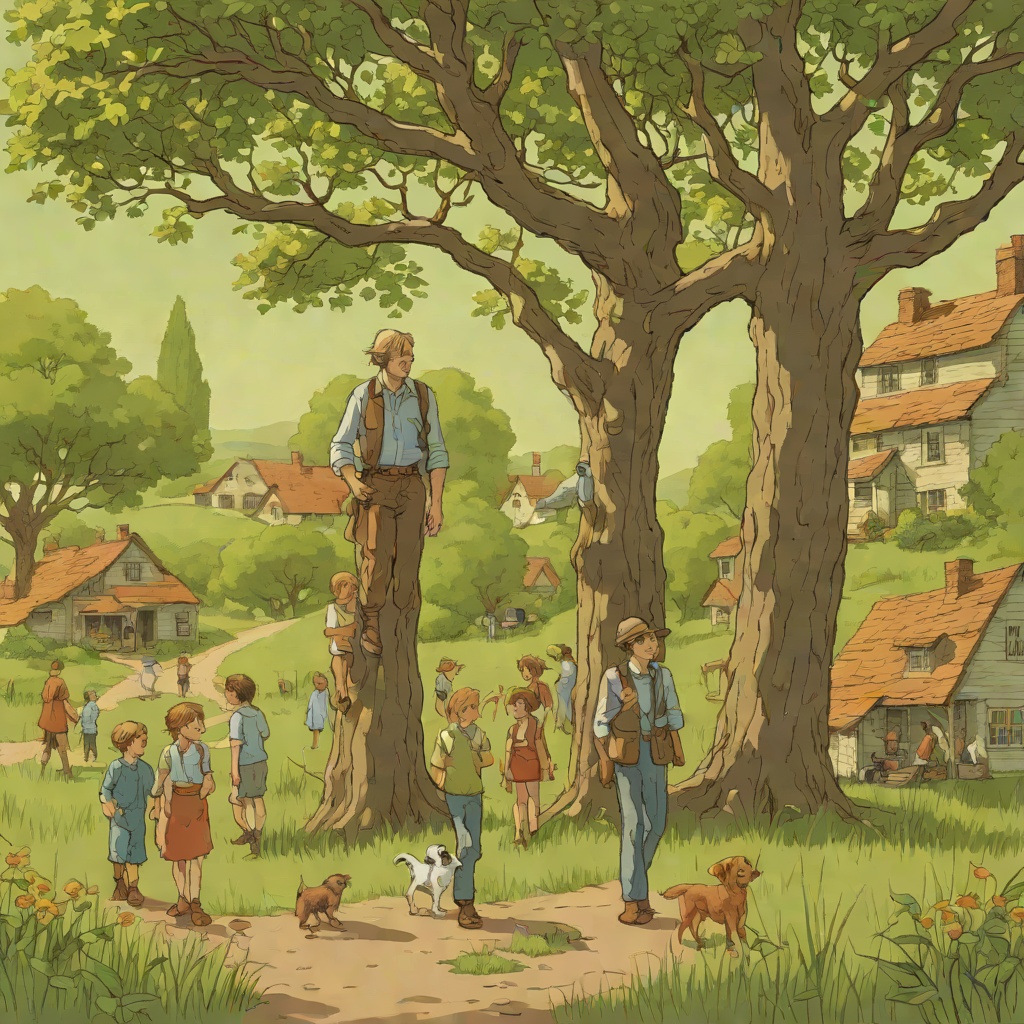
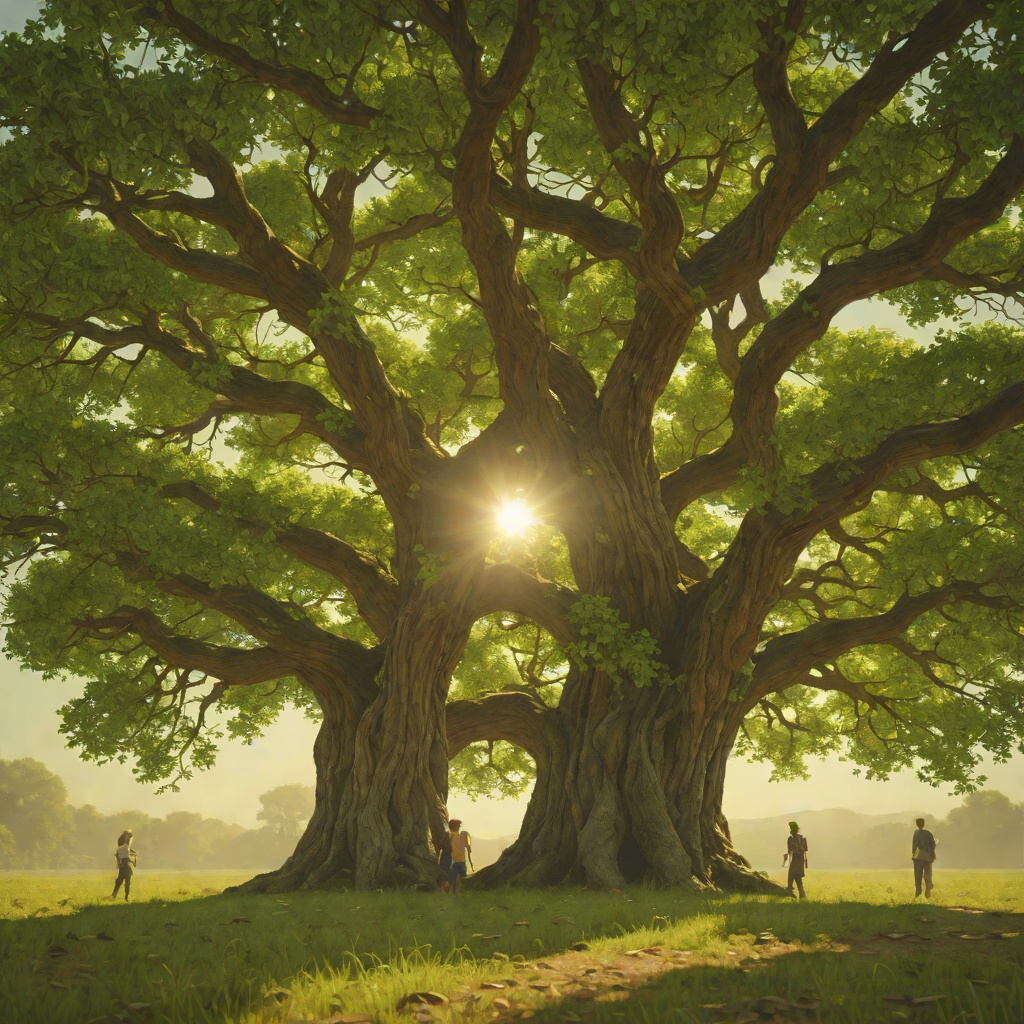
“Wisha, wisha, wisha”
The Faraway Tree“Wisha, wisha, wisha” is the characteristic whisper of the trees in the Enchanted Wood, a repeated sound that makes the forest an active participant in the children’s adventures. It first accompanies their entry into the wood and later guides their return to The Faraway Tree, creating a sonic refrain for the boundary between ordinary life and the magical lands above.
Sound and Meaning
Dick notices that the leaves seem to make a strange noise, as though the trees were talking to one another and telling secrets. The repeated “Wisha, wisha, wisha, wisha” is therefore presented not as ordinary rustling but as apparent speech. The sound gives the woodland a social life of its own: the trees possess something to communicate, even if their message remains inaccessible to Dick at first.
Bessie explains that the children can hear what the trees say by pressing their left ears to the trunks. This detail turns listening into a small ritual and gives the forest’s voice a physical method of reception. The trees are not merely described as alive in a figurative sense; the children are taught to approach them as possible communicators. The phrase consequently joins sound, touch, secrecy, and initiation, inviting Dick into a form of knowledge that the familiar human world does not provide.
First Appearance at the Wood’s Threshold
The expression is heard just after the children cross the narrow ditch between the lane and the wood. Dick has stopped in astonishment inside the trees, and the whispering is among his first experiences of the Enchanted Wood. Jo then urges everyone onward toward The Faraway Tree, so the sound frames the movement from the ordinary lane into the place where the queer magic tree stands.
Its placement at this threshold gives the phrase structural importance. The children do not simply walk into a forest and later discover magic; they encounter an atmosphere of concealed conversation before reaching the central tree. The whispering thus prepares the reader for a world in which plants, animals, toys, and other nonhuman beings may act, speak, labor, or assist. It also establishes secrecy as a recurring quality of the wood: the trees appear to know more than the children, and their repeated syllables preserve that knowledge without translating it into ordinary language.
Repetition and Return
The trees speak again when the children leave the house at night to seek The Faraway Tree. They move through the dark garden and into the little lane, where the Enchanted Wood looms large and dark. As they enter, the trees softly repeat “Wisha, wisha, wisha,” and the children cross the ditch and follow the paths they know well.
This later occurrence changes the phrase from a first-contact marvel into a recurring sign of orientation and continuity. The wood is dark, but the trees’ familiar voice remains recognizable. Lanterns carried by the fairy folk provide practical light, while the whisper provides an equally important sense of place: the children know that they have re-entered the enchanted environment because its living background has resumed speaking. The repeated sound therefore binds separate episodes together without needing to explain the changing lands at the top of The Faraway Tree.
The Forest as a Living Network
The expression gains force through its contrast with the many other forms of communication in the story. The Saucepan Man repeatedly mishears human speech, turning “Dick” into “Chick” and then “Stick,” and even doubts his accurate hearing when the children report that they have heard a cat sing. Other messages rely on explicit instructions, such as the blue notice directing visitors to knock once, ring twice, and rattle the letter-box. Against these precise or defective human exchanges, “Wisha, wisha, wisha” remains nonliteral and atmospheric, a communication whose existence is clear while its exact content is withheld.
The broader woodland also confirms that communication is distributed among species. A red squirrel in a jersey collects Moon-Face’s cushions, ties them to a rope, and signals for them to be pulled upward. Later, Jo depends on the woodpecker’s knowledge of wood and its strong beak to create a passage into The Slippery-Slip. Six woodpeckers eventually work in a row, pecking rapidly enough to produce a drumming echo. These actions make the trees’ whisper part of a larger pattern in which the nonhuman world is not decorative: it supplies information, labor, rescue, and routes of movement.
Narrative and Thematic Significance
As a recurring expression, “Wisha, wisha, wisha” functions like an oral refrain. Its slight variations, including “Wisha-wisha-wisha-wisha,” preserve the impression of continuing speech rather than a single isolated sound. Repetition creates recognition, while the lack of a translated message protects the forest’s otherness. Readers can understand the narrative function of the whisper without being given the secret itself.
The phrase also sustains the book’s movement between natural and supernatural interpretation. Leaves can make a sound, but within this world the sound is treated as a conversation; the children’s willingness to test that possibility is part of their imaginative education. The expression never needs to become a decoded statement to matter. It signals that the Enchanted Wood has its own voice, that entry into its mysteries requires attention, and that the children’s adventures take place within a living network rather than upon an inert backdrop.